
Environmental Product Declaration
VELUX Modular Skylights - Triple Glazing Configuration
by VELUX
Environmental Product Declaration (EPD) for VELUX Modular Skylights - Triple Glazing Configuration, manufactured by VELUX. Declaration SmartEPD-2026-077-1130-01, prepared according to IBU PCR Part B: Requirements on the EPD for Windows and Doors v1.0/1.7/1.4, valid until November 5, 2031.
- Declared unit
- 1 m² of product of a window ≤ 2.3 m² (reference dimensions according to EN 17213: 1.23 m × 1.48 m)
- Valid until
- November 5, 2031
- PCR
- IBU Part B: Windows and Doors v1.0/1.7/1.4
Declaration details
- Manufacturer
- VELUX
- Program operator
- Smart EPD
- Declaration number
- SmartEPD-2026-077-1130-01
- Date of issue
- November 5, 2026
- Valid until
- November 5, 2031
- Product category rules (PCR)
- IBU PCR Part B: Requirements on the EPD for Windows and Doors v1.0/1.7/1.4
- Standard
- ISO 14025:2006 and EN 15804:2012+A2:2019/AC:2021
- Declared unit
- 1 m² of product of a window ≤ 2.3 m² (reference dimensions according to EN 17213: 1.23 m × 1.48 m)
- System boundary
- Cradle to gate with other options (A1 - A3, A4, A5, C1 - C4, D)
- Product specificity
- Product Specific
- Manufacturing specificity
- Facility Specific
- Manufacturing plant
- Østbirk (Østvej 2, Ostbirk, Denmark)
- Product category
- Openings › TranslucentWallAndRoofAssemblies
- Product SKU
- VMS HVC 1230x1480 - Triple Glazed (0016TB)
- Verifier
- Rifat Karim, Independent Consultant
- LCA software
- SimaPro 10.2
- Program instructions
- Smart EPD General Program Instructions v.2.0, March 2025
Life cycle assessment results
Results per 1 m² of product of a window ≤ 2.3 m² (reference dimensions according to EN 17213: 1.23 m × 1.48 m).
Environmental Impact Assessment Results
| Indicator | Unit | A1-A3 | A4 | A5 | C1 | C2 | C3 | C4 | D |
|---|---|---|---|---|---|---|---|---|---|
| GWP-total | kg CO2 eq | 2.08e+2 | 2.45e+0 | 1.36e+0 | 0 | 6.43e-1 | 7.78e+0 | 1.06e-1 | -2.27e+1 |
| GWP-biogenic | kg CO2 eq | 7.66e-1 | 8.21e-4 | 2.97e-1 | 0 | 2.15e-4 | 5.12e-4 | 1.94e-5 | -2.07e-3 |
| GWP-fossil | kg CO2 eq | 2.07e+2 | 2.45e+0 | 1.07e+0 | 0 | 6.42e-1 | 7.78e+0 | 1.06e-1 | -2.26e+1 |
| GWP-luluc | kg CO2 eq | 1.81e-1 | 1.20e-3 | 1.30e-5 | 0 | 3.13e-4 | 5.92e-5 | 1.26e-5 | -2.98e-2 |
| ODP | kg CFC11 eq | 3.76e-6 | 5.56e-8 | 1.34e-9 | 0 | 1.46e-8 | 8.02e-9 | 1.59e-9 | -8.18e-7 |
| AP | mol H+ eq | 1.28e+0 | 6.07e-3 | 2.80e-4 | 0 | 1.59e-3 | 1.78e-3 | 9.56e-4 | -8.46e-2 |
| EP-freshwater | kg P eq | 3.48e-2 | 1.81e-4 | 4.36e-6 | 0 | 4.74e-5 | 2.33e-5 | 5.37e-6 | -4.81e-3 |
| EP-marine | kg N eq | 2.82e-1 | 1.65e-3 | 1.53e-4 | 0 | 4.33e-4 | 1.01e-3 | 4.29e-4 | -1.54e-2 |
| EP-terrestrial | mol N eq | 2.41e+0 | 1.70e-2 | 1.32e-3 | 0 | 4.45e-3 | 8.65e-3 | 4.66e-3 | -1.72e-1 |
| POCP | kg NMVOC eq | 7.89e-1 | 9.91e-3 | 3.54e-4 | 0 | 2.60e-3 | 2.18e-3 | 1.40e-3 | -7.15e-2 |
| ADP-minerals&metals | kg Sb eq | 1.01e-3 | 6.85e-6 | 7.96e-8 | 0 | 1.80e-6 | 3.75e-7 | 3.79e-8 | 9.21e-5 |
| ADP-fossil | MJ | 2.85e+3 | 3.72e+1 | 3.54e-1 | 0 | 9.74e+0 | 1.44e+0 | 1.36e+0 | -2.68e+2 |
| WDP | m3 depriv. | 1.16e+2 | 1.78e-1 | 4.82e-2 | 0 | 4.65e-2 | 3.53e-1 | 3.02e-3 | -6.13e+0 |
Resource Use Indicators
| Indicator | Unit | A1-A3 | A4 | A5 | C1 | C2 | C3 | C4 | D |
|---|---|---|---|---|---|---|---|---|---|
| PERE | MJ | 3.48e+2 | 5.44e-1 | 1.04e-2 | 0 | 1.43e-1 | 5.90e-2 | 1.12e-2 | -9.21e+0 |
| PERM | MJ | 6.70e+1 | 0 | 0 | 0 | 0 | 0 | 0 | 0 |
| PERT | MJ | 4.15e+2 | 5.44e-1 | 1.04e-2 | 0 | 1.43e-1 | 5.90e-2 | 1.12e-2 | -9.21e+0 |
| PENRE | MJ | 2.85e+3 | 3.72e+1 | 3.54e-1 | 0 | 9.74e+0 | 1.44e+0 | 1.36e+0 | -2.68e+2 |
| PENRM | MJ | 8.65e-1 | 1.57e-3 | 1.50e-5 | 0 | 4.11e-4 | 6.36e-5 | 1.59e-5 | 5.86e-3 |
| PENRT | MJ | 2.85e+3 | 3.72e+1 | 3.54e-1 | 0 | 9.74e+0 | 1.44e+0 | 1.36e+0 | -2.68e+2 |
| SM | kg | 7.89e+0 | 0 | 0 | 0 | 0 | 0 | 0 | 0 |
| RSF | MJ | 0 | 0 | 0 | 0 | 0 | 0 | 0 | 0 |
| NRSF | MJ | 0 | 0 | 0 | 0 | 0 | 0 | 0 | 0 |
| FW | m3 | 2.99e+0 | 5.04e-3 | 1.53e-3 | 0 | 1.32e-3 | 1.11e-2 | 7.26e-5 | -1.48e-1 |
Waste and Output Flow Indicators
| Indicator | Unit | A1-A3 | A4 | A5 | C1 | C2 | C3 | C4 | D |
|---|---|---|---|---|---|---|---|---|---|
| HWD | kg | 0 | 0 | 0 | 0 | 0 | 0 | 0 | 0 |
| NHWD | kg | 4.07e+0 | 0 | 1.14e-1 | 0 | 0 | 0 | 3.70e+1 | 0 |
| RWD | kg | 2.47e-3 | 1.13e-5 | 1.47e-7 | 0 | 2.97e-6 | 7.31e-7 | 1.60e-7 | -1.59e-6 |
| CRU | kg | 0 | 0 | 0 | 0 | 0 | 0 | 0 | 0 |
| MFR | kg | 5.35e+0 | 0 | 1.01e-1 | 0 | 0 | 2.12e+1 | 0 | 0 |
| MER | kg | 0 | 0 | 0 | 0 | 0 | 0 | 0 | 0 |
| EE | MJ | 3.32e+1 | 0 | 7.15e+0 | 0 | 0 | 8.88e+1 | 0 | 0 |
Carbon Emissions and Removals
| Indicator | Unit | A1-A3 | A4 | A5 | C1 | C2 | C3 | C4 | D |
|---|---|---|---|---|---|---|---|---|---|
| Bio Carbon Removal from Product | kg CO2 | 0 | 0 | 0 | 0 | 0 | 0 | 0 | 0 |
| Bio Carbon Emission from Product | kg CO2 | 0 | 0 | 0 | 0 | 0 | 0 | 0 | 0 |
| Bio Carbon Removal from Packaging | kg CO2 | -7.00e+0 | 0 | 0 | 0 | 0 | 0 | 0 | 0 |
| Bio Carbon Emission from Packaging | kg CO2 | 6.69e+0 | 0 | 3.10e-1 | 0 | 0 | 0 | 0 | 0 |
| Bio Carbon Emission from Waste during Manufacturing (renewable source) | kg CO2 | 0 | 0 | 0 | 0 | 0 | 0 | 0 | 0 |
| Calcination Carbon Removal | kg CO2 | 0 | 0 | 0 | 0 | 0 | 0 | 0 | 0 |
| Carbonation Carbon Emission | kg CO2 | 0 | 0 | 0 | 0 | 0 | 0 | 0 | 0 |
| Carbon Emission from Waste during Manufacturing (non-renewable source) | kg CO2 | 0 | 0 | 0 | 0 | 0 | 0 | 0 | 0 |
ND = not declared. Life cycle modules: A1-A3 product stage, A4-A5 construction process, B use stage, C end of life, D benefits and loads beyond the system boundary.
Material composition
| Material/Component Category | Origin | % Mass |
|---|---|---|
| Aluminum profile | DK | 1.67 |
| Fasteners | DK | 0.26 |
| Gaskets, washers | DK | 0.18 |
| Hard plastics | DK | 0.27 |
| Insulated glass | DK | 75.89 |
| Other polymer parts | DK | 0.01 |
| Others | 1.0 | |
| Sash | DK | 13.95 |
| Sealing, gaskets | DK | 0.83 |
| Steel | DK | 5.94 |
| Packaging material | Origin | Mass (kg) |
|---|---|---|
| Cardboard | EU | 0.11 |
| Pallet | EU | 0.07 |
| Plastic cover | EU | 0.55 |
| Biogenic carbon content | kg C per m² |
|---|---|
| Biogenic carbon content in product | 0 |
| Biogenic carbon content in accompanying packaging | 0.08 |
Hazardous substances
No regulated hazardous or dangerous substances are included in this product.
Scenarios
Transport to the building site (A4)
- Fuel type
- Diesel
- Vehicle type
- Truck and Trailer
- Transport distance
- 350 km
- Capacity utilization
- 33%
- Weight of products transported
- 69.91 kg
- Packaging mass
- 0.73 kg
End of life (C1-C4)
- Collected separately
- 69.18 kg
- Recycling
- 21.15 kg
- Landfill
- 36.99 kg
- Incineration
- 11.03 kg
Benefits and loads beyond the system boundary (D)
- Recycling rate of product
- 30.58%
- Recycled content of product
- 9.50%
- Net energy benefit from energy recovery in C3, declared as exported energy
- 88.80 MJ
Product description
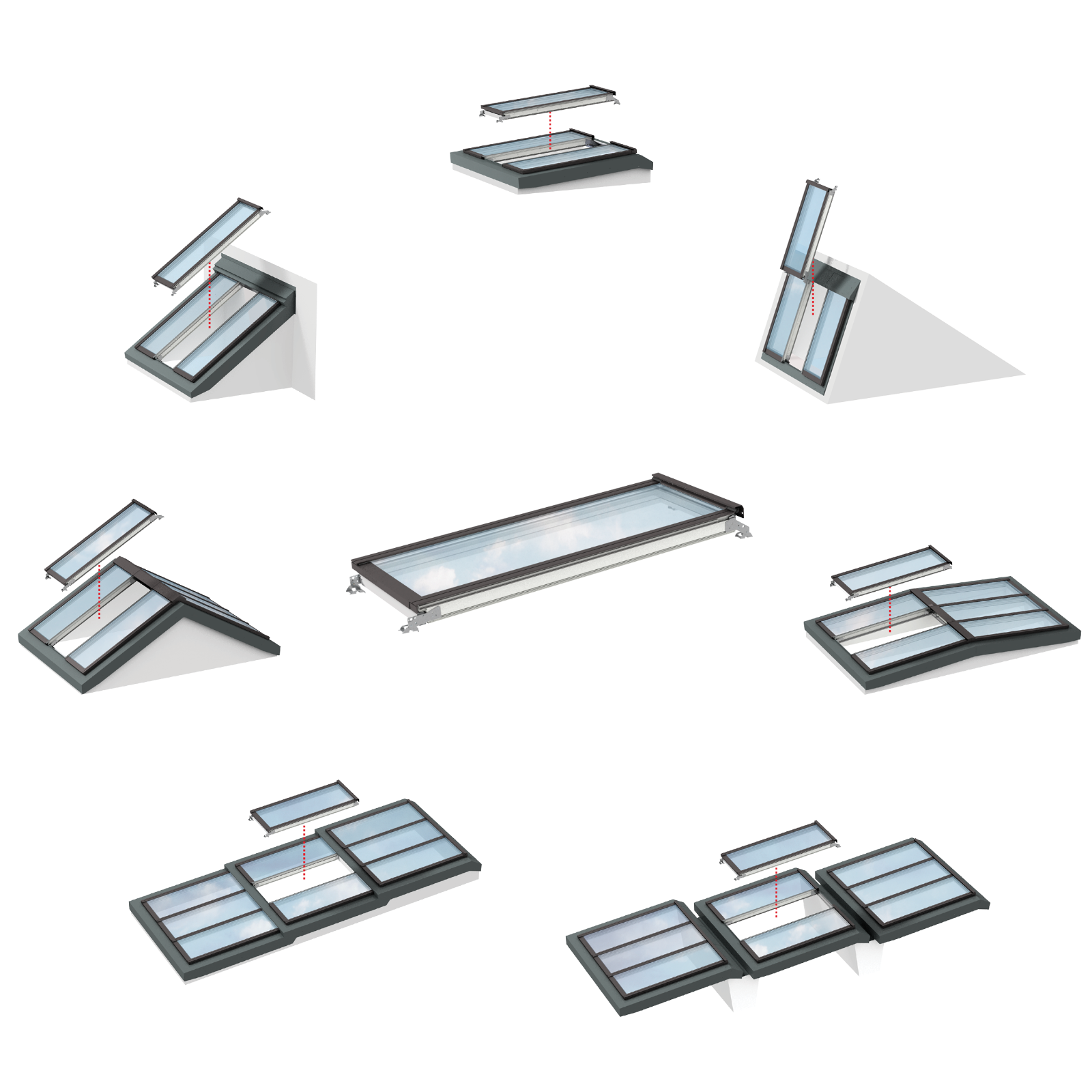
VELUX Modular Skylights (VMS) are sash-frame constructed single roof windows and are CE-marked in accordance with EN 14351-1. The modules fit together and can be configured in several predefined daylight solutions. The skylights come as fixed or venting modules and are delivered with dedicated factory finished flashings to ensure watertightness in every solution. The EPD covers VMS modules in sizes from 0.405 m² up to 2.3 m², the chain actuator (motor) is not included in this EPD. The glass panes are triple glazing and different glass configurations are covered by the EPD. The glass thickness ranges from 18 to 22 mm. The glass panes have cavities filled with Argon gas others with Krypton. The representative glass configuration used for the EPD calculations has 8 mm toughened glass, 12 mm spacer, 4 mm toughened glass, 12 mm spacer and 10 mm laminated glass. This configuration is conservative with regards to the environmental impact results. The product has a reference service life of 30 years according to EN 17213.
Interpretation
The manufacturing of the products in this analysis involves the direct procurement of raw materials from suppliers. These materials are then transported to manufacturing facilities in the EU where they are stored, processed, and combined to produce finished products. Notably, the product stage has the highest impact contribution, mainly attributed to the environmental impacts of raw material manufacturing.
Given that the raw materials used in product manufacturing have a significant impact, exploration of opportunities to substitute these materials with alternatives that have a lower environmental impact. Additionally, consideration should be given to collaborating with suppliers who employ sustainable manufacturing techniques or integrate more renewable energy into their production processes. Such initiatives can lead to more environmentally friendly products and further enhance the sustainability of the products in this analysis.
LCIA results are relative expressions and do not predict impacts on category endpoints, the exceeding of thresholds, safety margins or risks. EPDs are comparable only when they follow the same PCR, functional unit and system boundary. The full EPD (PDF) contains the methodology, scenario assumptions and verification statement.