Environmental Product Declaration
SBS-Modified Asphalt Roofing (Self-Adhered)
by CertainTeed Saint-Gobain
Environmental Product Declaration (EPD) for SBS-Modified Asphalt Roofing (Self-Adhered), manufactured by CertainTeed Saint-Gobain. Declaration SmartEPD-2025-060-0386-01, prepared according to UL Part B: Asphalt Shingles, Built-up Asphalt and Modified Bituminous Membrane Roofing, valid until April 1, 2030.
Download the EPD (PDF)
- Declared unit
- 1 m2 of product
- Valid until
- April 1, 2030
- PCR
- UL Part B: Asphalt Shingles, Built-up Asphalt and Modified Bituminous Membrane Roofing
Declaration details
- Manufacturer
- CertainTeed Saint-Gobain
- Program operator
- Smart EPD
- Declaration number
- SmartEPD-2025-060-0386-01
- Date of issue
- April 1, 2025
- Valid until
- April 1, 2030
- Product category rules (PCR)
- UL Part B: Asphalt Shingles, Built-up Asphalt and Modified Bituminous Membrane Roofing (version 3)
- Standard
- ISO 14025:2006 and ISO 21930:2017
- Declared unit
- 1 m2 of product
- System boundary
- Cradle to gate with other options (A1 - A3, A4, A5, C1 - C4)
- Product specificity
- Product Average
- Manufacturing specificity
- Facility Specific
- Manufacturing plant
- Little Rock (2701 E Roosevelt Rd, Little Rock, AR, USA)
- Product category
- Cladding › RoofPanels
- Verifier
- Sarah Curpen
- LCA software
- Sphera LCA for Experts (formerly GaBi) 10.9
- Program instructions
- Smart EPD General Program Instructions v.1.0, November 2022
Life cycle assessment results
Results per 1 m2 of product.
Environmental Impact Assessment Results
Resource Use Indicators
Waste and Output Flow Indicators
Carbon Emissions and Removals
ND = not declared. Life cycle modules: A1-A3 product stage, A4-A5 construction process, B use stage, C end of life, D benefits and loads beyond the system boundary.
Material composition
Hazardous substances
No substances required to be reported as hazardous are associated with the production of this product
Scenarios
Transport to the building site (A4)
- Fuel type
- Diesel
- Vehicle type
- Standard Freight Trailer
- Transport distance
- 800 km
- Capacity utilization
- 100%
- Packaging mass
- 0.63 kg
End of life (C1-C4)
- Collected with mixed construction waste
- 6.30 kg
- Landfill
- 6.30 kg
- Product or material for final disposal
- 6.30 kg
Product description
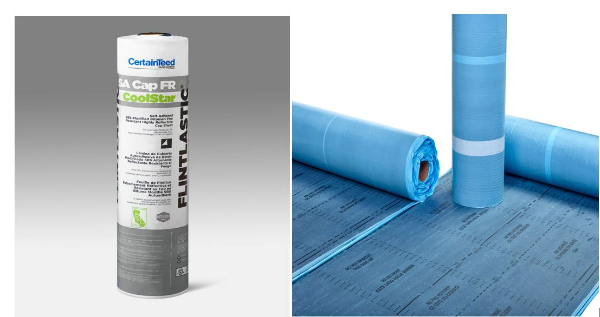
Commercial manufactures asphalt-base or bituminous, multi-layer, low-slope, commercial roof systems. Roof systems may consist of one or multiple materials depending on desired performance, warranty, and cost. Roof systems, at minimum include a base sheet and a cap sheets. Most base sheets can also be installed as interply layers . CertainTeed offers over forty roll good products, which equates to hundreds of system configurations and specification options. This EPD is specific to the SBS-Modified Asphalt Roofing (Self-Adhered) products. SBS-modified asphalt products are manufactured with styrene-butadiene-styrene infused asphalt which increases flexibility, especially in low temperatures. Additionally, some products listed as “FR” are manufactured with proprietary additives to increase fire resistance. CertainTeed SBS-modified asphalt roofing systems can be applied by four different application methods: self-adhered, hot asphalt, cold adhesive, or torch-applied. Though hot asphalt and cold adhesive are distinct application methods, the CertainTeed products used for these applications are the same and for the purposes of this study, they are grouped together as one application method.
Reinforcement mats serve as the structure to bituminous low-slope roll goods. The mats are impregnated and coated with SBS-modified asphalt. Products are available with either fiberglass or polyester reinforcement which can vary in thickness and weight. Fiberglass stands up well to heat and tension. Its inherently high melting point affords superior fire resistance when combined with a fire-retardant asphalt formulation. Fiberglass-reinforced products applied in hot asphalt retain excellent dimensional stability. When combined with SBS-modified asphalt, the sheets will resist roof movement until the stress absorbed in the mat forces a break. Polyester’s predominant benefits are puncture resistance and high elongation. Polyester products handle rooftop foot traffic better. They can also cyclically absorb the strain of building movement and return back to their original dimension.
CertainTeed SBS-modified asphalt roofing systems can be applied by four different application methods: self-adhered, hot asphalt, cold adhesive, or torch-applied. Each application method results in excellent adhesion when applied correction. Self-adhered (SA) sheets are valued for their ability to be installed quickly and with less kill when compared to the other application methods. Benefits also include minimized health and safety risks as they require no solvent-based adhesive, kettle or torch for heating so there are no fumes, and no burn/fire risk. And despite successfully being in service for almost twenty years (CertainTeed introduced their self-adhered product line in 2003), self-adhered systems are not yet widely accepted for commercial roofing projects. They are, however, very popular on residential low-slope projects and represent the fastest growing product type within the bituminous segment. Hot asphalt is proven, durable, and cost-effect, and limited by fumes, burn risk, and require the availability of highly skilled labor and appropriate equipment.
Interpretation
Based on the results of the life cycle assessment, the life cycle impacts are strongly driven by the raw materials and installation phases. Within the raw materials, the mats and coatings, and where included, the fire retardant metals, contributed significantly to the environmental impact potentials. Installation methods vary among the products in the study and installation for specific projects varies widely depending on the project, products used, applications, etc. This makes specific installation data difficult to obtain. Due to the variable nature of the installation methods and materials, the results for the installation phase of the life cycle should be considered highly uncertain. The results for individual products within each of the product lines specified in this study vary slightly compared to the averages reported in this EPD, typically due to the coatings and presence of fire retardant metals in the raw material composition.
LCIA results are relative expressions and do not predict impacts on category endpoints, the exceeding of thresholds, safety margins or risks. EPDs are comparable only when they follow the same PCR, functional unit and system boundary. The full EPD (PDF) contains the methodology, scenario assumptions and verification statement.
