Environmental Product Declaration
CertainTeed Veneered Ceiling & Wall Panels, Veneered Linear & Grille Products, and Solid Wood Linear & Grille Products
by CertainTeed Saint-Gobain
Environmental Product Declaration (EPD) for CertainTeed Veneered Ceiling & Wall Panels, Veneered Linear & Grille Products, and Solid Wood Linear & Grille Products, manufactured by CertainTeed Saint-Gobain. Declaration SmartEPD-2024-046-0208-01, prepared according to UL Part B: Non-Metal Ceiling and Interior Wall Panels, valid until November 14, 2029.
Download the EPD (PDF)
- Functional unit
- 0.093 m2 of product installed product
- Valid until
- November 14, 2029
- PCR
- UL Part B: Non-Metal Ceiling and Interior Wall Panels
Declaration details
- Manufacturer
- CertainTeed Saint-Gobain
- Program operator
- Smart EPD
- Declaration number
- SmartEPD-2024-046-0208-01
- Date of issue
- November 14, 2024
- Valid until
- November 14, 2029
- Product category rules (PCR)
- UL Part B: Non-Metal Ceiling and Interior Wall Panels (version 2)
- Standard
- ISO 14025:2006 and ISO 21930:2017
- Functional unit
- 0.093 m2 of product installed product
- System boundary
- Cradle to gate with other options (A1 - A3, A4, A5, C1 - C4)
- Product specificity
- Product Specific
- Manufacturing specificity
- Manufacturer Average, Facility Specific
- Manufacturing plant
- CertainTeed Architectural (16065 Imperial Pkwy, Strongsville, OH 44149, USA)
- Product category
- Finishes › CeilingPanel › AcousticalCeilings
- Verifier
- Sevda Alanya Rosenbaum
- LCA software
- GaBi 10.0
- Program instructions
- Smart EPD General Program Instructions v.1.0, November 2022
Life cycle assessment results
Results per 0.093 m2 of product installed product.
Environmental Impact Assessment Results
Resource Use Indicators
Waste and Output Flow Indicators
Carbon Emissions and Removals
ND = not declared. Life cycle modules: A1-A3 product stage, A4-A5 construction process, B use stage, C end of life, D benefits and loads beyond the system boundary.
Material composition
Hazardous substances
No hazardous substances in this product.
Scenarios
Transport to the building site (A4)
- Fuel type
- Diesel
- Vehicle type
- Standard Freight Trailer
- Transport distance
- 800 km
- Capacity utilization
- 85%
- Packaging mass
- 0.38 kg
End of life (C1-C4)
- Landfill
- 3.97 kg
- Product or material for final disposal
- 3.97 kg
Product description
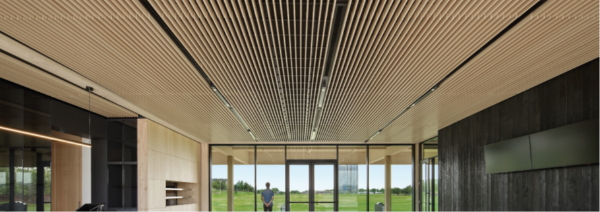
This study investigates three distinct product categories that share similar production and formulation processes. Veneered Ceiling & Wall Panels, Veneered Linear & Grille Products, and Solid Wood Linear & Grille Products are all fabricated at CertainTeed's Strongsville, OH plant. Veneered Ceiling & Wall Panels are available in a variety of ceiling and wall installation methods and sizes. These panels provide many options for ceilings and walls, along with a wide variety of veneer species, cuts, and finishes. There are additional custom and fully engineered options available, including shapes, sizes, suspension and mounting systems, design returns and trims, and finishing options, for design flexibility. Many veneered panels achieve a noise reduction coefficient of up to 0.85 NRC and are manufactured with low-emitting and sustainable materials and components.
Grille Modules (Veneered Linear & Grille Products, and Solid Wood Linear & Grille Products) offer a dimensional, linear design that complements various design elements, installation requirements, and acoustic performance. These modules provide flexibility with multiple blade heights and widths, as well as a range of natural solid woods, veneers, finishes, configurations, and installation methods. The products consist of wood boards, slats, planks, or baffles that are panelized to facilitate installation. CertainTeed Wood Grille Modules come in a variety of standard and custom configurations to complement design elements, installation requirements, and acoustic performance, with a wide array of solid wood and veneer species, cuts, and finishes. Select installation options allow for fully-accessible installation in both ceiling and wall applications. These modules can achieve a noise reduction coefficient of up to 1.15 NRC and are manufactured with low emitting and sustainable materials and components.
Interpretation
The data pertaining to the operation of the Strongsville, OH facility, were directly obtained from CertainTeed Corporation. The data were meticulously scrutinized for internal consistency, and cross-verified with plant personnel. The researchers recommend sub-metering of energy use for each critical stage in the manufacturing process to allow for a more detailed analysis. It is important to note that the findings of this research are limited by the inherent uncertainty of creating a representative model through Life Cycle Assessment (LCA). The modeling of the product system involved numerous assumptions,
including representative processes and datasets. While quality control measures were implemented at each step of building the Life Cycle Inventory (LCI) and conducting the Life Cycle Impact Assessment (LCIA), the results are inevitably subject to uncertainty since the data represents only one year of manufacturing information from Strongsville, OH . A detailed evaluation of more time periods would serve to reduce this uncertainty. Manufacturing contributes more than 50% to the overall global warming potential (IPCC AR5, Excluding biogenic). In terms of raw material impacts, stain and MDF account for 42% and 26% of the total raw material global warming potential (IPCC AR5, Excluding biogenic) impacts for veneer panels, respectively. For Veneer Grille and Linear Systems, MDF contributes 30% to the raw material global warming potential (IPCC AR5, Excluding biogenic), and for Solid Wood Grille and Linear Systems, 87% of the raw material global warming (IPCC AR5, Excluding biogenic) impact stems from solid wood.
Incorporating more recycled content into the products could help reduce the environmental impacts associated with raw materials. Increasing energy efficiency at the Strongsville, OH manufacturing facility could help to reduce the overall environmental impacts for all product groupings. Furthermore, identifying alternate uses or recycling options for the product at the end of its life will reduce end-of-life impacts and potential raw materials burdens of recycled products. The results also suggest a strong link between product mass and embodied emissions, with heavier or larger products having higher emissions. Lightweighting the product (using less mass per functional unit) would reduce the impact of the product.
LCIA results are relative expressions and do not predict impacts on category endpoints, the exceeding of thresholds, safety margins or risks. EPDs are comparable only when they follow the same PCR, functional unit and system boundary. The full EPD (PDF) contains the methodology, scenario assumptions and verification statement.
